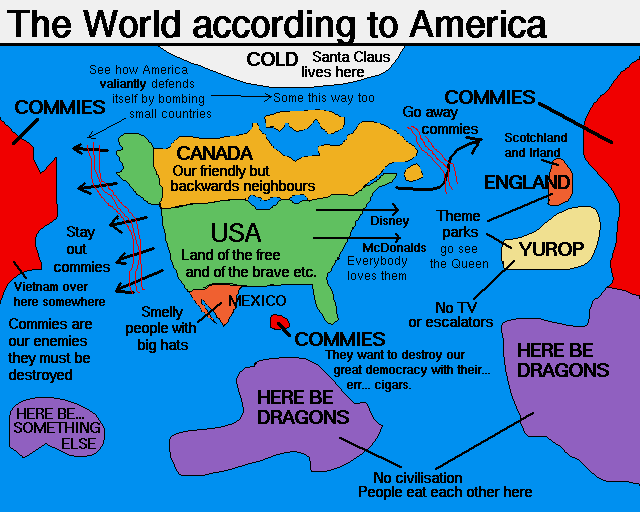
Oh dear...

Oh dear...

Favorite Post Q4

My favorite post from quarter three is my post entitled "Gross
National Happiness."

I think that this post did a successful job of combining succinct descriptions of unknown terms with links to more elaborate descriptions. I also think that I did a good job of mixing my own theories with those of the hosts of "Stuff You Should Know."

Wednesday, March 31, 2010

Should We Trust The Powerful

You may have heard about the new book, No One Would Listen.  The book was written by Harry Markopolos, who for years tried to tell people at the SEC about Bernie Madoff's ponzi scheme.  No one would listen for two reasons (that he claims).

1) Bernie Madoff is too big and powerful.  Look at the people who invest with him.  Look at the kind of money that he makes. It is simply impossible for someone this powerful to run a ponzi scheme.
--Markopolos claimed that Madoff's returns, a 45 degree angle, "are only present in geometry class."  He wrote copious letters to different people in the SEC, but no one took his evidence seriously.

2) The SEC is run by incompetent lawyers.  Instead of putting financial men in charge, the SEC put lawyers in charge.  The lawyers didn't know anything about the way that the money buisness worked, and therefore found themselves unable to notice when financial men took diabolical liberties with the law.
-- On the daily show he said that he would "love to get in there and fire some people."

This makes me wonder, should we trust anyone merely because they appear "really good" at what they are doing.  Let us take this moment to think of all the times that we took information on authority.  Now, let's think about all the times that those people were wrong.  It seems counterintuitaive, we want to trust the successful, but there has to be a better way to find people to trust.

See Me as an individual

I see a theme in my last two posts, I have talked about the way that seeing people as individuals, instead of in groups, can greatly change your conscience thinking about them.

Why is it that seeing people as individuals, instead of groups of people makes such a drastic difference.  There are many groups that  I could say I am in: New Trier Student, Wilmette resident, Independent Liberal, Car Magazine reader, Rowing Team Member.  But do any of these groups explain me as a person.

A few weeks ago I heard one of the most interesting stories that I have ever heard on NPR.  It was a story about mothers of deceased Palestinian and Israeli combatants who met every so often.  As one mother put it, "it took us no time at all to realize that we were all the same."  I got goosebumps.

It really goes to show how much personalizing a situation can do.  I went recently on an exchange program with Kenwood Academy on the South Side.  I will admit, before going I had some stereotypes about inner-city schools.  Most of them were blown away by the individuals that I met. 

Why, then, if we are able to truly know people so much better seeing them as a single, do we continue to sort? I know that when I meet people I sort them into all kinds of categories based on their activities, gender, intelligence, and political views.  Is this right, probably not.  Why do I do it? If you sort people, Why do you do it?

Tuesday, March 30, 2010

Careless Lives Cost Talk

In a book that I recently finished, Mere Christianity, C.S. Lewis makes arguments for living a "christian" lifestyle.  At one point in the book, he urges Christians to live responsibly and "like a christian" because, "careless lives cost talk."  This, of course, is a play on the war poster to the left.

I think that this is a really insightful way into the way that humans, myself included, judge groups of people.  He said that when people see Christians acting poorly, it gives all Christians a bad name.  That is definitely true, I would be lying If I hadn't ever seen a Pat Robertson quote and gotten mad at all Christians as one.

Is it fair to group people like this.  On the one hand, Christianity is different than say race or gender.  People do not choose these traits, but they do choose religion.  If you have all chosen to be in this religion, you must all be like-minded, right?

That doesn't make sense, how can the millions or billions of Christians who subscribe to the words written in the Bible be assumed to have the same interpretations of the book, or even the same actions.

This seems to be something that I will have to work on: not judging whole groups en masse.  Have you ever judged a whole group based on one person only to discover that you made a gross miscalculation?

Monday, March 29, 2010

Where does morality Come From

The other day, on the way to crew,  I was discussing with a friend where we thought morality comes from.  A note, by morality, I mean a conscious feeling of right and wrong.

He said that this feeling of right and wrong "could be god... it is a possibility."

I disagreed.  I am not going to speak of the varying of morals between societies. Instead, I said that because human's are pack animals, those of us who felt the most empathy for other humans lived and reproduced and natural selection had its way with the rest.  To back this up even more, I pointed to the way that empathy in humans manifests itself.  One does not feel nearly as guilty killing a thousand people across the world with a button as you would killing one man with a knife.  This is because seeing the human face, and empathizing with it, causes your conscience to tell you you are doing something wrong.  I said that people do good things for similar reasons; they see others in situations that they could imagine themselves in.

He responded with, "What do you think about people who give to charity anonymously to people that they have never met or seen." I think that there are two reasons for this.  It makes you feel good about yourself and even if you haven't seen someone, that doesn't mean that you haven't imagined them.

Whose side do you take on this argument? Before you tell me, I am aware that this post was probably biased towards my argument.

Friday, March 26, 2010

Is Racism the same as seeing Race?

I've been brooding over Harry Reid's comment on Obama's skin for Quite some time.  Now, late as always, I think I've come to a conclusion about whether or not his comment was justified or even excusable.  In case you have been living under a rock for a few months, he said that Obama had a real chance of winning the presidential election because he was, "light skinned... with no negro dialect unless he wanted to have one."

A lot of republicans called foul on this because their former majority leader, Trent Lott, was a strong supporter of a segregationist and therefore had to resign.  The difference between the two is so striking, I don't understand why anyone would compare the two.  Lott used a type of thinking that was outdated and not at all appropriate in our society.

Reid, on the other hand, realized that black politicians who tend to win are 'more white.'  I think that this term is rather racist, because the term 'more white' tends to refer to things like using advanced vocabulary and living a bourgeoisie lifestyle. 

I think that many Americans are aware of the fact that most black representatives are 'more white' yet are afraid to say so.  Why?  Well, it is much easier to ignore racism than to try to tackle it.  Personally, I think that the real racism exists in our ideas about what is 'more white.'  So, is Reid excusable? Yes, despite the use of outdated language he was saying something that is accepted to be true. Are we? Not yet.  We consider Obama the first Black president despite the fact that he is half white.  We are so far from 'post racism' that it scares me.

Thursday, March 25, 2010

Literal Fear Mongering...

A lot of people argued that the Bush Administration took part in fear mongering to push their agenda through.  Of course I have my opinions on that, but what about companies fear mongering.  Surely no one would buy into that...

Wait, of course they do.  Lots of people buy security systems, yet I was unable to find any real study that found that there was any real correlation between being protected by a sercurity system and lowering your chances of being robbed.  My family locks our doors and our house has never been robbed.  There has been one robbery on my block in my lifetime, and that house had an ADT sign in the front yard.

Why do people buy in, lets take a look at the always relevant Sarah Haskins.


I would be willing to bet that the majority of people who have security systems are either single mothers or a couple and that very few are men.  These comercials love to target women.  Aparently it works, because they keep doing it.

Wednesday, March 24, 2010

The New Hippy

I heard somewhere (probably NPR) though I can not seem to remember, that the Tea Party radicals are to conservatives what Hippies were for Liberals in the 60's.

If the Hippies helped influence many of the social reforms that have occurred in the past forty years, does this mean that in 40 years, we will have receded back into a reactionary state of formality and conservatism.

I obviously can't tell what the future holds, but I can make hypothesis from the past.  Hippies are remembered for more than their great music and excessive drug use.  They also dramatically changed American society.  They helped with Civil Rights battles and marched for Vietnam.

How would our modern society differ without them, I can't know for sure but I'm willing to guess it would be far more conservative.

What do the tea partiers stand for?  I don't know exactly.  Do they stand just for smaller government or will we be seeing constitutional bans on abortion and gay marriage.  I guess only time will tell, but tell me what you think the Tea Party stands for and how they will effect America.  Because, one thing is for sure, they aren't going anywhere.

Tuesday, March 23, 2010

Healthcare Reform... Good or Bad

I just found out that the healthcare reform bill has, indeed, signed into law. I smiled when I first saw it, then I realized that I have no idea what it is and I am supporting a party (the democrats) not a bill.

From my own research, I know that this bill will insure another 30 million or so Americans (though I am not sure how).  It will also tighten restrictions on the way that insurance companies can ration coverage.  Beyond that, I'm not sure that it does that much to change our country into a socialists state.

From my fiscally conservative mom, I have learned that this bill is "longer than sin" and that no one really knows what is in it.  I would say that most bills are very long, so I'm not exactly sure what her argument is there.  Also, I cannot corroborate that no one has read it.  In fact, I found this eloquently laid out (if possibly biased) site that explains the bill in clear english and less than a page.

My dad tells me that this bill will help to lower costs overall for everyone.  Instead of paying for the uninsured when you go to the emergency room (that is why you get charged $150 for an aspirin and a "walk it off"), we will more efficiently spread the money throughout the healthcare system in a way that will cut out waste.  According to him, there is also a bipartisan think tank that concluded that the bill will save money compared to the current system.  I can't remember the name, but I will ask him and update this post.

So overall, I think that the argument against the bill has been hyperbole.  I am not a big fan of the social issues that republicans stand on, and therefore tend to prefer to disagree with them on fiscal issues as well (we all like to be told that we are right).  According to this post, I think I support the bill, but if you have arguments to the contrary, fill me in.

How Much Money Makes You Happy?

After we talked about it in class, it got me thinking; how much money makes you happy?

In many studies, it has been found that at a certain point, money stops making you happy.  For instance, according to a recent international survey, slum dwellers in Calcutta rated themselves as about as happy as millionaires in America and Northern Icelandic Inuits rated the same as American millionaires.  Then, does money buy happiness?

Well, to a point it is rather clear that it does, because the homeless in Calcutta were far less happy than American millionaires.  So, what gives? Well, Harvard Professor, Daniel Gilbert says that it has been, "generally concluded that wealth increases human happiness when it lifts people out of abject poverty and into the middle class but that it does little to increase happiness thereafter."

I guess that makes sense, but with the fear of sounding terribly snobbish, there are certain quite expensive things that I love.  My family is fortunate enough to have a summer cottage and a relatively expensive ski boat.  I would say that while at our cottage in Wisconsin, I feel generally more content than in Chicago, not to mention that boating is also a very fun pastime, and gas for a V8 boat is not cheap.

Would I be less happy if we didn't have the boat and the house? I don't know.  I have a few hypothesis as to the relationship between wealth and happiness:

1) those who are wealthy only believe that they are becoming happier, when in truth, they are becoming less and less content with what they have.

2) People who truly need money to feel happy, work hard and get it.  One of my friend's dads came from rather meager means (lower middle class) and worked hard to get into law school then get a job at a private firm.  I'm not saying that everyone who wants to be wealthy gets there, but a lot do.

3) People can naturally feel content with just one rung above what they have, so long as they have the general necessities of life (food, shelter etc.), therefore, I feel relatively content with what I have, but would not want less because I have had a taste of "the good life" and would not could not imagine having tons more (Buchanan type wealth).

What do you think?  Does wealth cause happiness, or does happiness come from people's own desires (which for some may include wealth) or does wealth deter happiness? I would love to hear your hypothesis.