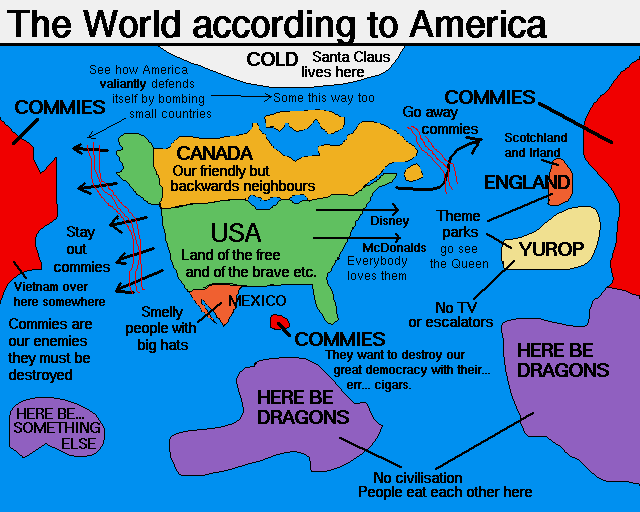
Oh dear...

Oh dear...

Favorite Post Q4

My favorite post from quarter three is my post entitled "Gross
National Happiness."

I think that this post did a successful job of combining succinct descriptions of unknown terms with links to more elaborate descriptions. I also think that I did a good job of mixing my own theories with those of the hosts of "Stuff You Should Know."

Tuesday, March 23, 2010

How Much Money Makes You Happy?

After we talked about it in class, it got me thinking; how much money makes you happy?

In many studies, it has been found that at a certain point, money stops making you happy.  For instance, according to a recent international survey, slum dwellers in Calcutta rated themselves as about as happy as millionaires in America and Northern Icelandic Inuits rated the same as American millionaires.  Then, does money buy happiness?

Well, to a point it is rather clear that it does, because the homeless in Calcutta were far less happy than American millionaires.  So, what gives? Well, Harvard Professor, Daniel Gilbert says that it has been, "generally concluded that wealth increases human happiness when it lifts people out of abject poverty and into the middle class but that it does little to increase happiness thereafter."

I guess that makes sense, but with the fear of sounding terribly snobbish, there are certain quite expensive things that I love.  My family is fortunate enough to have a summer cottage and a relatively expensive ski boat.  I would say that while at our cottage in Wisconsin, I feel generally more content than in Chicago, not to mention that boating is also a very fun pastime, and gas for a V8 boat is not cheap.

Would I be less happy if we didn't have the boat and the house? I don't know.  I have a few hypothesis as to the relationship between wealth and happiness:

1) those who are wealthy only believe that they are becoming happier, when in truth, they are becoming less and less content with what they have.

2) People who truly need money to feel happy, work hard and get it.  One of my friend's dads came from rather meager means (lower middle class) and worked hard to get into law school then get a job at a private firm.  I'm not saying that everyone who wants to be wealthy gets there, but a lot do.

3) People can naturally feel content with just one rung above what they have, so long as they have the general necessities of life (food, shelter etc.), therefore, I feel relatively content with what I have, but would not want less because I have had a taste of "the good life" and would not could not imagine having tons more (Buchanan type wealth).

What do you think?  Does wealth cause happiness, or does happiness come from people's own desires (which for some may include wealth) or does wealth deter happiness? I would love to hear your hypothesis.

Monday, March 22, 2010

Resuscitation of American Schools...

A few days ago I posted on the book, The Death and Life of the Great American School System in my post Are American Schools Dying.  A few days later, I found out about this New York Times Article.

It appears that there may be a totally uniform rule of what students need to learn to pass each grade and eventually graduate.  ON the one hand, this will certainely help create a better environment of equality for all schools, because they will all have the same graduation requirements.

On the other hand, I have to wonder if classes like our AS would survive.  On top of that, will having the same graduation requirements really make American schooling equal.  There is, to begin with, discrepancy in the way that classes are taught and tests are written.  On top of that, at a competitive school like New Trier, students, I believe, will be more likely to graduate with classes that far exceed the graduation requirements.

So, I guess I don't support this standardization; it seems that it will do more bad than good.  I think that what we really need is a total rethink of American eduacational values.  We need to consider (and please respond in the comments) why we go to school, what an education is good for, if we want every student to receive exactly the same education, and if we want to reduce the succesfulness of our system to a few test scores.

Friday, March 19, 2010

To Profile or Not to Profile?

Many people say that we should profile at airport security because the majority of people looking to attack America are Middle Eastern and men.  Therefore, white blond women should not be searched at airports. 

I understand the argument, though I didn't agree with it, until recently when I read this New York Times article about Colleen LaRose, a white blond woman from the suburbs of Philadelphia.  She calls herself JihadJane online and she has not only contributed money to terrorist groups, but "expressed a desire to become a martyr for an Islamist cause."  This, according to the New York Times, is part of a trend of Al Qaeda finding whites who will blend into society and join their cause.

To me, this is not only a little frightening (I'll admit, my internal racism was a little comforting), but it also proves just how global (or local) our enemy is.  No longer can we cower in racism, we have to realize, and your granny will have to deal with the consequences that anyone, regardless of race could be an enemy.  Colleen doesn't look very 'foreign' (and therefore frightening) in the top picture, but if she were dressed like she is to the left, would it become justifiable to strip search her in an airport?  Does her turban make her a threat or is it the ideas stored within?

Thursday, March 18, 2010

Ideals Vs. the Real World... a real fight?

On The Daily Show about a week ago, Jon Stewart interviewed Marc Thiessen about the "torture memos" and America's interrogation policy and the newly dubbed "Al Qaeda 7."

The video is split into three parts and the first (which was the only that aired on TV) is below.  To see the second piece, go here.  To see the third, go here.

The Daily Show With Jon StewartMon - Thurs 11p / 10c
Marc Thiessen
www.thedailyshow.com
Daily Show
Full Episodes
Political HumorHealth Care Reform

Torture is always something that I have been unsure about and this argument is really one of the best, most thoughtful arguments that I have ever seen (whodda thunk that that would be on Comedy Central).

I really want to hear what other people have to say about this.  Personally, I love the idea that America is above torture and I definitely agree that we should only be OK with doing to "them" what we are OK if they do to us.  I wonder, though, am I being to realist.   This is an ugly world.  I may not necessarily think that there is anything inherently right about America's campaign in the world, but I do think that we have a right to protect ourselves.  On the other hand, we have been given many more resources with which to protect ourselves than our enemies and does that mean that we are unjustified in using "extreme techniques."  At the same time, one could easily argue that we did not start this war, and that we were only responding to an attack on America.  At the same time, you could say that the reason that we wrongfully attacked Iraq was because of enhanced interrogation and a coerced admission of connection between Iraq and Al Qaeda.  On top of that, many members in Al Qaeda are people who have been recruited after the US put the area into such disarray. At the same time, why does that justify their killing of civilians? No, so then where have I gotten, no where.

This is before I even consider the effectiveness of torture.

A Whole History....

This is a response to Doc Oc's post on the Texas textbook legislation (say that ten times fast).  Stephen Colbert did a piece on this recently and I thought it would make sense to bring this interview to light, especially seeing as how he used Eric Foner, author of our textbook, Give Me Liberty! as his guest.

The Colbert ReportMon - Thurs 11:30pm / 10:30c
I's on Edjukashun - Texas School Board
www.colbertnation.com
Colbert Report Full EpisodesPolitical HumorHealth Care reform

I think that we have all already heard about about the Texas School Board decision in Doc OC's Post (though this is a funny video).   I liked his comment on "American Exceptionalism,"  though I think that most textbooks will have to write textbooks that are missing a few things.

I was a little surprised by the fact that Foner said, "Yes, it is [a complete history of America]" because I expected the author of the textbook that we used to be a little more knowing of its exceptions, though he does admit that all textbooks have exceptions a little later.

Foner talks about the "redemptive arc" of America and how we Texas makes it look like we started perfect and got better instead of starting with problems and working for something better.

What do you think of Eric Foner the man and what would he think of our class?

Wednesday, March 17, 2010

Are American Schools Dying?

A book that has just come onto my radar and subsequently been added to my list of things to read is The Death and Life of the Great American School System. The LA Times Did a review that got me quite interested.

Diane Ravitch, the Author, was at one point a conservative when it came to schooling.  She believed in scantron testing and 'accountability.'  Now, she is a fan of O'colos style teaching, in that she prefers higher level thinking and synthesis.  This change in heart has been summed up in her book.

She says that test based schools have a plethora of shortfalls, namely that they do not inspire students to learn.  I couldn't agree with her more.  I feel like if I knew that at the end of each book that we read in AS we would receive a test, I would look through the book trying to remember facts instead of synthesizing the symbolism of different passages.

I love the O'colos style of learning, but what about the privatization of schools.  At one point, Ravitch was behind competition in the school market just like that in the economy.  Now, she says that school should be codependent.  I think that that is one of the most insightful things that she changed her opinion on.  The last thing that we need is to have teachers competing between schools for test scores instead of collaborating on ways to inspire students to learn.

Overall, I can't wait to get my hands on this book, but I wonder what you think.  Do you think that schools should be privatized and compete for government funding through tests?

Tuesday, March 16, 2010

Meds in ads...

In class we talked about the way that Medicine, specifically prescription medicine, is advertised in America.  Personally, I never understood this until I asked my mother in fourth or fifth grade.  As she explained it, "people like to think that pills will fix anything, if they see an ad, they tell themselves that their peoblem is big enough for medicine."

What do you think are the implications of a pill dependent society?  Personally, I am a big fan of medicine, it works much better than faith healing.

But what if people are taking too many pills.  I take a large handful of pills in the morning.  Except for one prescription that I was suggested by a doctor, I take mostly a series of Supplements (Vitamin B and Fish Oil) and Vitamins.  But do I even need these.  I don't know.

Meds also target women specifically, as my favorite TV commentator, Sarah Haskins points out.Is this any less justified?

Monday, March 15, 2010

Corruption in Government

I remember hearing somewhere that people are less trustworthy of politicians now than ever before in America.  Unfortunately, I was unable to corroborate this information with any sort of study or statistic, but I do think that we can take that as a truth.

This leads me to a question; why do we trust our leaders so little.  I think that there are two reasdons that we trust them less now than ever before.  I don't think that corruption has anything to do with it, government has always been a little corrupt.

The first reason that we distrust our politicians: the transparency of new technologies.  In the time of "honest Abe" there were no TVs or websites or blogs or even radios.  Because of this, the only way to hold meetings was behind closed doors where anything could happen.  Without C-span, no one knows what happened (written reports can easily be fudged or not taken down for certain meetings).  Beyond that, there is the ease with which old technologies are dispersed.  Think about the number of books regarding government corruption come out every month.  It is an astonishingly high number.

The second reason is the way that we believe our government is more corrupt is the shift in the way that we look at politicians.  JFK was not considered corrupt by most of America.  At the same time, many Americans would consider Mark Sanford or John Edwards or Bill Clinton corrupt.  The truth is that all four of these politicians had affairs.  We have changed our view of politicians from seeing them as professional figures to seeing them as celebrities that can be judged on every base of their life.

I definately think that having intensified views over our elected officials is important, but as I said in my post Elect The Unqualified, I think that personal lives are irrelevant to an elected official's credentials.

Friday, March 12, 2010

Smut for Smut...

You may or may not have heard about this, but when I heard about it, I couldn't decide what I thought about it.  Either watch the video below or, For a transcript, follow this link.


I am at most an agnostic, and I actually kind of find that I agree with the people who are doing this.  If you have read any of the parts of the Bible or Qu'ran or Torah, you know that there are lots of things that contradict both the views of society and the views of other pages in that text.

Overall I've come to two conclusions:

1) Tucker Carlson was extremely biased when giving this interview and seemed to disprove the theory that MSNBC is made up of ridiculous liberals.

2) I have to wonder why we think that holy texts are so 'holy' and I think that trading these sacred texts for pornography is a great way to bring to light the way in which we should view 'holy' texts.

Do you think that this is appropriate.  If not, fill me in.